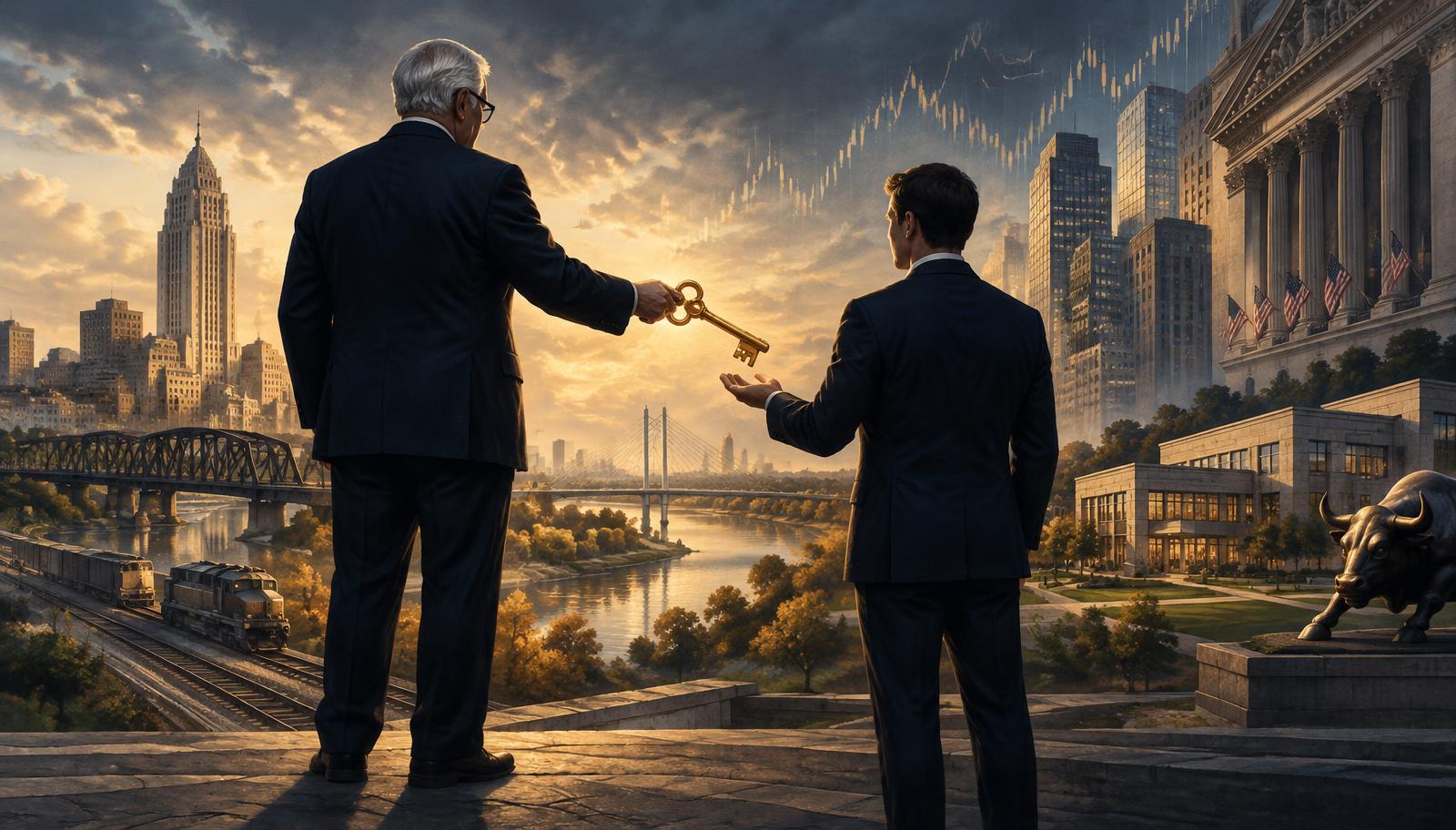
Buffett Steps Down As Berkshire Chair
Warren Buffett, 96, moves to chairman emeritus. Howard G. Buffett takes the chair. A macro trader's read on what changes, what doesn't, and how the market is likely to misprice the handover.
The News
Berkshire Hathaway said Friday that Warren Buffett, 96, will step down as chairman effective immediately and move to the chairman emeritus role. In his place as chair will be his son Howard G. Buffett, as has been telegraphed for years.
The market has known this was coming. What it did not know — and what always moves the tape — is the exact date. Now the date is here. And that changes the conversation from "what if?" to "what now?"
Source: Yahoo Finance.
What Howard Actually Inherits
Howard G. Buffett is not the operating CEO. Greg Abel is. Howard's role is the one that matters for the stock price over a decade: the guardian of the culture.
Berkshire is not a normal conglomerate. The whole structure — insurance float, permanent equity holdings, decentralised operating companies, minimal headquarters staff, and a refusal to overpay — is a machine built around one man's judgment of risk and time horizon. That machine has outperformed for sixty years because the person at the top had an unusually low cost of capital, an unusually long time horizon, and an unusually high tolerance for doing nothing.
Howard's stated job is to support Abel and defend that culture. In a 2024 Yahoo Finance interview, he said he would need to be "around to do my job" and that the risk level of his outside philanthropic and farming life "probably gets decreased." Translation: the board wants a Buffett name in the chair to signal continuity, while the operators actually run the businesses.
The Macro Trader's Read
The first thing to understand is that Berkshire Hathaway is a proxy for a specific regime. When rates were zero and growth was scarce, Berkshire's cash pile, insurance float, and operating leverage looked boring. In a higher-rate, late-cycle world, its cash generation, regulated utilities, railroad, and energy assets look like exactly what you want.
The stock has outperformed not because the businesses are glamorous, but because the capital allocation has been disciplined. Warren did not chase. He bought when others sold, held when others traded, and let compound interest do the work.
The question is no longer "Can Warren do it again?" It is "Can the institution do it without him?" That is a different question, and the honest answer is: we do not know yet. The market will give the new structure a grace period, but not forever.
Three Scenarios For BRK-B
Howard keeps the board aligned with long-term capital allocation. Abel continues to run operations. Berkshire stays patient, cash-rich, and counter-cyclical. The stock keeps its premium and likely grinds higher with the market. Base case.
Without Warren's singular authority, the board approves larger, more speculative deals. Capital allocation becomes more conventional. The "Buffett premium" compresses and BRK-B trades closer to a sum-of-the-parts discount. This is the slow-burn risk.
If the conglomerate discount widens far enough, activists or the board itself could push to spin off the railroad, utilities, or insurance operations. Value-unlock event for some holders, but it would mean the end of the Berkshire model as we know it. Tail risk, not base case.
The Signal In The Noise
Markets will try to turn this into a trading event. They will look at the announcement, the age, the succession, and the inevitable obituaries that have been pre-written for a decade. My read is simpler: nothing about the operating business changed today.
What changed is the timeline. The market now has to discount a Berkshire Hathaway that is no longer run by the person who built it. That is a modest re-rating risk, not a crisis. If you owned BRK-B for Buffett, you were already making a bet on the institution. Today's news just makes that bet explicit.
For the broader market, this is another reminder that the old guard is leaving. Buffett, Munger already gone, and the next cycle of capital allocation will be done by people who grew up in a very different interest-rate and liquidity environment. That matters more than any single stock.
The One-Liner
Berkshire was never just a stock. It was a proof of concept that patience, discipline, and long-dated thinking could still win in a market built for speed. Howard G. Buffett's job is to make sure that proof of concept survives its founder. The market will find out over the next five years whether culture is stronger than any one person.
I'm not a lawyer.