Three Dissents, A Broken Level, And Three Very Different Prints: Fed, MSFT, META And QCOM
The Fed held at 3.50%–3.75% and three presidents voted to hike — the first triple hawkish dissent since 2016. The Dow lost 1,100 points, the S&P closed at 7,316, the Nasdaq made it six down days and the SOX fell more than 5% with Micron down double digits. Then the tape got Microsoft up, Meta down, Qualcomm down. Here is what actually broke, and whether there is more pain ahead.
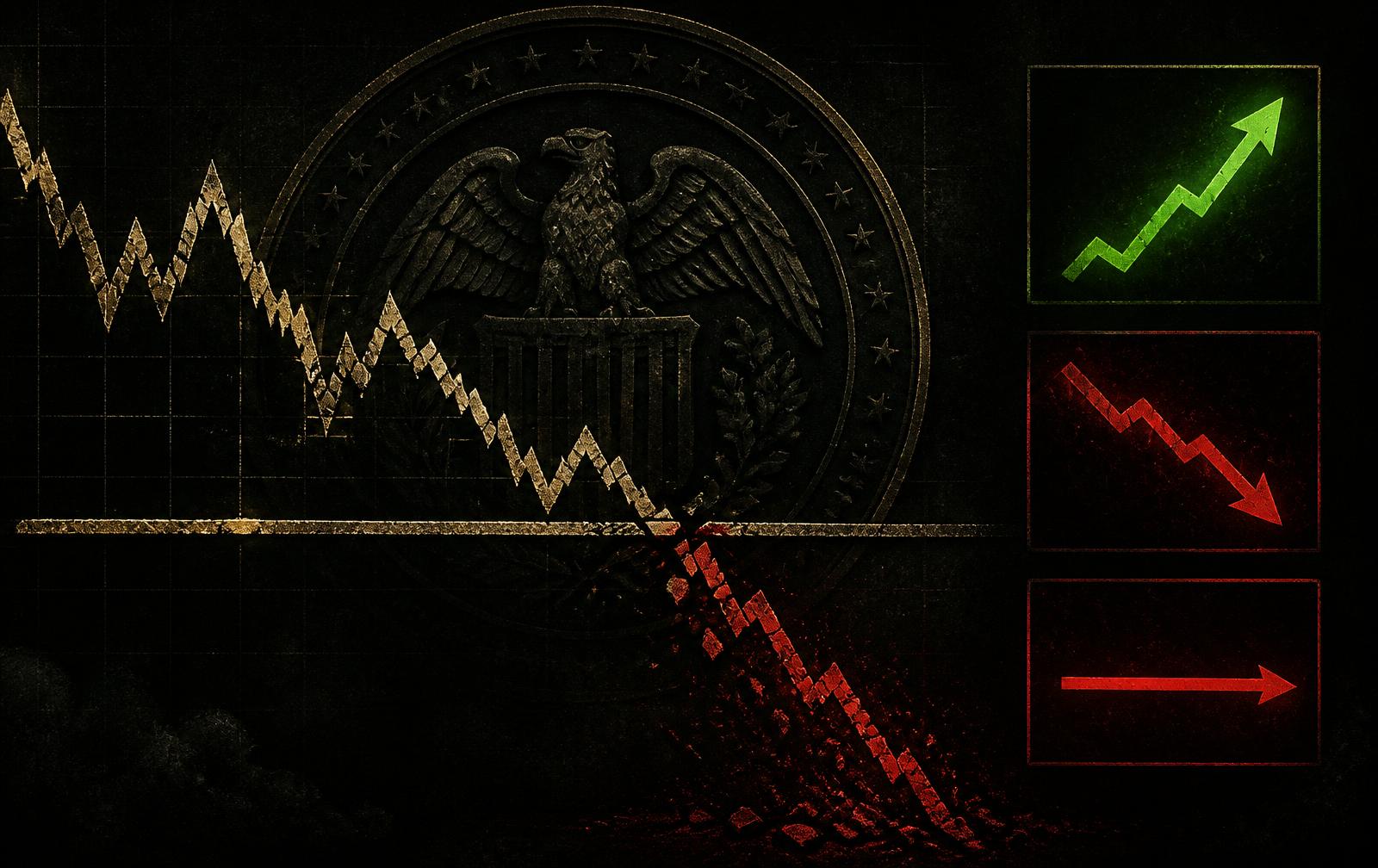
The Fed did not cut, did not hike, and still managed to be the most hawkish thing that happened all month. Nine to three, rates held at 3.50%–3.75%, and three regional presidents voted to raise. Three dissents in the same direction has not happened since 2016. That is not a hold. That is a warning shot.
The tape read it correctly. The Dow gave back more than 1,100 points and closed down 2.19% at 51,594. The S&P lost 1.52% to 7,316. The Nasdaq Composite fell 1.74% to 24,443 — its sixth straight down day. The Philadelphia semiconductor index dropped more than 5% and Micron was down double digits. Crude ripped, with Brent up over 6% back above $90 on Houthi tanker attacks and US-Saudi strikes in Iraq. Tesla lost $300 for the first time in about a year.
Then, after the close, three of the biggest prints of the season landed inside forty minutes and immediately disagreed with each other. Microsoft up. Meta down hard. Qualcomm down. That disagreement is the whole story, and it is more useful than any single number in the releases.
What The Fed Actually Did — And Why Three Dissents Matter
The decision was expected. The vote was not. A 9–3 hold with all three dissents arguing for a hike tells you the internal debate has flipped from 'how fast do we ease' to 'do we need to tighten again.' Markets had spent months pricing the first of those questions. Today they had to start pricing the second.
You could see it in the front end and in the dollar before you could see it in equities. Two-year yields moved, the curve repriced, and every long-duration, no-earnings, story-driven asset on the board got marked down for it. That is mechanical. When the terminal rate assumption stops falling, the multiple you are willing to pay for cash flows five years out stops rising.
The important part is not the July meeting. It is September. Three dissenters do not vanish; they campaign. Every inflation and jobs print between now and the next meeting is now a two-sided risk instead of a one-sided one, and a market that has been trading a one-sided rate path for a year has to widen its distribution. Widening distributions mean lower gross exposure. Lower gross exposure means selling.
Did It Just Break Levels? Yes — And The Character Of The Break Matters
I have been writing about the 740 line on SPY and the 735 shelf underneath it since July 23. Today's close on the S&P at 7,316 puts the broad tape below the shelf I said would decide the range, on the sixth consecutive down day for the Nasdaq, with the semis leading down 5%. That is not noise. That is a level failing on volume with the right leadership sequence.
But look at how it broke. The selling was concentrated: memory and chips got destroyed, software found support, and defensives and energy caught real money. That is not a liquidation. In a liquidation everything trades the same, and today things very much did not. This was a rotation executed at high speed under a hawkish headline.
The distinction matters for what comes next. A liquidation break gets bought back inside a week because forced supply exhausts itself. A rotation break keeps grinding, because the money leaving does not come back — it changed its mind about what it wants to own. Today looked like the second one.
So my working level map: 7,316 on the S&P was the break. The next real shelf is the July low area, and I want to see whether the first bounce off it is sold. If the bounce is sold on lighter volume with the semis still lagging, the tape has more work to do. If breadth expands on the bounce and the SOX outperforms, the break was a flush and I'll treat it as one.
Microsoft: The Only Print That Justified Its Capex
Microsoft delivered the cleanest number of the night. Revenue $90 billion, up 18% and ahead of the roughly $87.6 billion the Street wanted. Operating income up 18% to $40.6 billion. GAAP EPS $4.81, up 32%. Azure grew 43% against a 40% bar, and Nadella put a flag in the ground: Azure crossed $100 billion in annual revenue for the first time, and Microsoft 365 Copilot is past 30 million paid seats. The stock traded up over 4% before settling around +2.5%.
Two things in there I care about more than the headline. First, commercial RPO up 84% to $678 billion — but the company disclosed that ex-OpenAI, RPO growth was 25%. That is honest disclosure and it is also the whole debate in one line. Twenty-five percent is a very good number for a business that size. Eighty-four percent is a number that includes one enormous related-party commitment, and the market has learned to discount those.
Second, there were one-time items: a $3.2 billion Anthropic investment gain worth about $0.33 of EPS, a small OpenAI gain, Xbox severance and impairment charges. Strip it all out and adjusted EPS was $4.74 against roughly $4.24 expected. It still beats. That is the point — Microsoft is the one name in this group that can show you the ugly version of its own quarter and still clear the bar.
More Personal Computing fell 4%, Windows OEM and devices down 7%, Xbox content down 10%. Nobody cares tonight, and they shouldn't. This is a cloud company with a consumer hardware appendix.
Meta: Revenue Fine, Everything Under It Is Not
Meta did $60.8 billion in revenue, up 28% and slightly ahead of the roughly $60.2 billion consensus. Ad impressions up 14%, price per ad up 12%. On the top line, the advertising machine is still one of the best businesses ever assembled.
Underneath, it got ugly. GAAP net income $15.85 billion, down 14%. Diluted EPS $6.18 against $7.22 expected — that is a wide miss. Roughly $3.58 billion of it is one-time: $2.4 billion in legal charges and $1.18 billion of severance from the May layoffs. The tax rate went from 11% to 16%. Total costs and expenses rose 55% to $42 billion. Operating margin went from 43% to 31%. Stock fell over 7% to about $541.
The number that actually scared people: operating cash flow $31.86 billion against capex of $31.08 billion. Free cash flow of $784 million. On a company this size, that is a rounding error. Meta is now converting essentially all of its operating cash into infrastructure, and Reality Labs is still losing $4.6 billion a quarter on $431 million of revenue.
And they raised the floor on spending. Full-year capex guidance moved from $125–145 billion to $130–145 billion, the tax rate outlook went from 13–16% to 15–17%, and Q3 revenue was guided to $61–64 billion. The market's question all week was whether Big Tech would blink on AI spend. Meta answered by spending more and earning less, and the stock got marked for it immediately.
I want to be fair to the business: ex-charges, Meta's core is still growing high-twenties with pricing power. But you do not get paid a growth multiple for a company whose free cash flow just went to zero and whose margin fell twelve points. Multiples pay for cash, not narrative.
Qualcomm: The Print Nobody Wanted To Own
Qualcomm closed the regular session down 4.4% at $155.68 and then dropped another 5%-plus after hours on a mixed fiscal Q3. Consensus was roughly $9.69 billion of revenue and $2.22–2.23 EPS. Same day, the company closed its $3.9 billion Modular acquisition and announced a decade-long BMW chip agreement — good strategic news that bought them nothing.
Two comments off the call did the damage. The company flagged a broad-based increase in semiconductor industry costs, and it pointed to non-handset revenue growth of 60%-plus in 2027. Read those together and you get: margins compress now, the diversification payoff arrives later. That is the exact trade the market is refusing to fund this week.
This is also why the SOX fell 5% while software held. The cost line in semis is going up — memory, packaging, wafer, everything — and the buyers on the other side are the same hyperscalers who are now being punished for spending. Somebody in that chain has to eat it, and the tape is voting that it will be the component suppliers, not the cloud landlords.
The Real Signal: The AI Trade Just Split In Two
Put the three prints on one page. Microsoft spends enormous money and can show you $100 billion of Azure revenue and 43% growth to pay for it. Meta spends enormous money and shows you $784 million of free cash flow. Qualcomm sells into the buildout and is telling you its own costs are going up faster than its handset business can absorb.
That is not one AI trade anymore. It is three. Monetizers, spenders, and suppliers. Since 2023 they all traded as one basket, and today the market started pricing them separately — hard, in a single session, under a hawkish Fed.
This is the same lesson I wrote about with memory five weeks ago, just one level higher up the stack. I said then that treating 'memory' as one thing was my mistake, because MU and the periphery were two different trades wearing the same jersey. Now the whole AI complex is doing it. Money is getting selective, and selective money leaves the periphery first.
So the shopping list changes. You want the names that can convert AI spend into disclosed, auditable revenue and still generate cash. You do not want the names whose entire case is 'the spending will pay off eventually,' because 'eventually' is a duration asset and the Fed just told you duration got more expensive today.
More Pain Ahead? Here Is My Honest Read
Short answer: more chop and more rotation, and yes, probably more downside in the crowded names before this resolves. But I do not think this is the start of a crash, and I want to be precise about why.
The bear case is real. Six down days on the Nasdaq, a broken level, semis down 5%, a Fed with three hawkish dissenters, crude back above $90 pushing headline inflation the wrong way at exactly the wrong moment, and the largest spender in Big Tech just told you it will spend more while earning less. Every one of those is a legitimate reason to carry less risk.
The offsetting case: Microsoft just printed a genuinely excellent quarter, software held up all day while chips got hit, Starbucks beat and raised and ran 10%, and money did not run to cash — it ran to energy and defensives. Markets that are actually breaking do not rotate; they liquidate. This one rotated.
Three things decide the next two weeks. One: the September Fed repricing — if the market starts putting real odds on a hike, multiples compress again across the board. Two: crude. Brent above $90 on supply-chain geopolitics is an inflation input the Fed cannot ignore and cannot fix. Three: whether the semis stop making new relative lows. The SOX is the tell for the whole complex, and until it stops leading down, bounces in AI names are for renting, not owning.
How I'm positioned around it: smaller. Energy stays my cleanest long — today confirmed it again with a real bid, not a hedge bid. I'd rather own the monetizers than the spenders in tech, and I have no interest in catching the falling component suppliers until the cost commentary stops getting worse. Cash is a position and this is a week to hold some of it.
What Would Change My Mind
Bullish flip: the S&P reclaims the shelf it just lost on expanding breadth, the SOX outperforms on the bounce, and crude fades back under $85 without an equity selloff attached. That would tell me today was a hawkish-headline flush inside an ongoing rotation, and I'd add back beta.
Bearish escalation: the first bounce gets sold on lighter volume, software finally cracks and joins the chips, and the front end keeps pricing hike risk. That combination takes the tape to the next shelf quickly, and I'd be sizing down further rather than buying the dip.
Between those two, I trade the rotation, not the index. That is what this tape is paying for right now.
Not Financial Advice
This is my opinion and my read of the tape as of publication on the evening of July 29, 2026. Earnings figures are as reported by the companies and as covered in press reports on the day; after-hours prices move and can differ materially from where these names open tomorrow. Nothing here is investment advice or a recommendation to buy, sell, or short any security. Positions can change without notice, and levels discussed here can invalidate in a single session. Do your own work before risking capital.
This essay reflects the personal views and opinions of Guy Gentile and is published for informational and educational purposes only. It is not investment advice, a recommendation to buy or sell any security, an offer or solicitation, or a research report. Markets carry risk and any positions, setups, or names discussed may change without notice. Mr. Gentile and parties affiliated with him may hold, add to, reduce, or close positions in the securities discussed at any time. Do your own research and consult a licensed financial professional before making investment decisions. Past performance is not indicative of future results.
Premarket notes, trade setups, and op-eds — free, in your inbox. Read more →