Part IV — Fraud on the Court: Naming Sajjad Matin, the SEC Staff Attorney Who Built the SureTrader Case in the Dark — and Gurbir Grewal, the SEC Enforcement Director Who Owned It
An investigative reading of the draft Office of Inspector General complaint prepared by Ford O'Brien Landy LLP on behalf of Guy Gentile in 2023 — the document that catalogs, in legal-memorandum form with dates, ECF cites, and Bates-numbered exhibits, what SEC Staff Attorney Sajjad Matin did to a Bahamian broker-dealer's employee between August 2015 and 2019 to build the case the Southern District of Florida tried in 2024 under Enforcement Director Gurbir Grewal: the threat letter, the ignored cease-and-desist from Bahamian counsel, the suspiciously-timed 'whistleblower' submission, the discovery-stayed federal docket Matin investigated around, the secretly recorded executive meeting Matin did not stop, and the false or misleading statements to the Bahamian regulator that the trial jury never heard about.
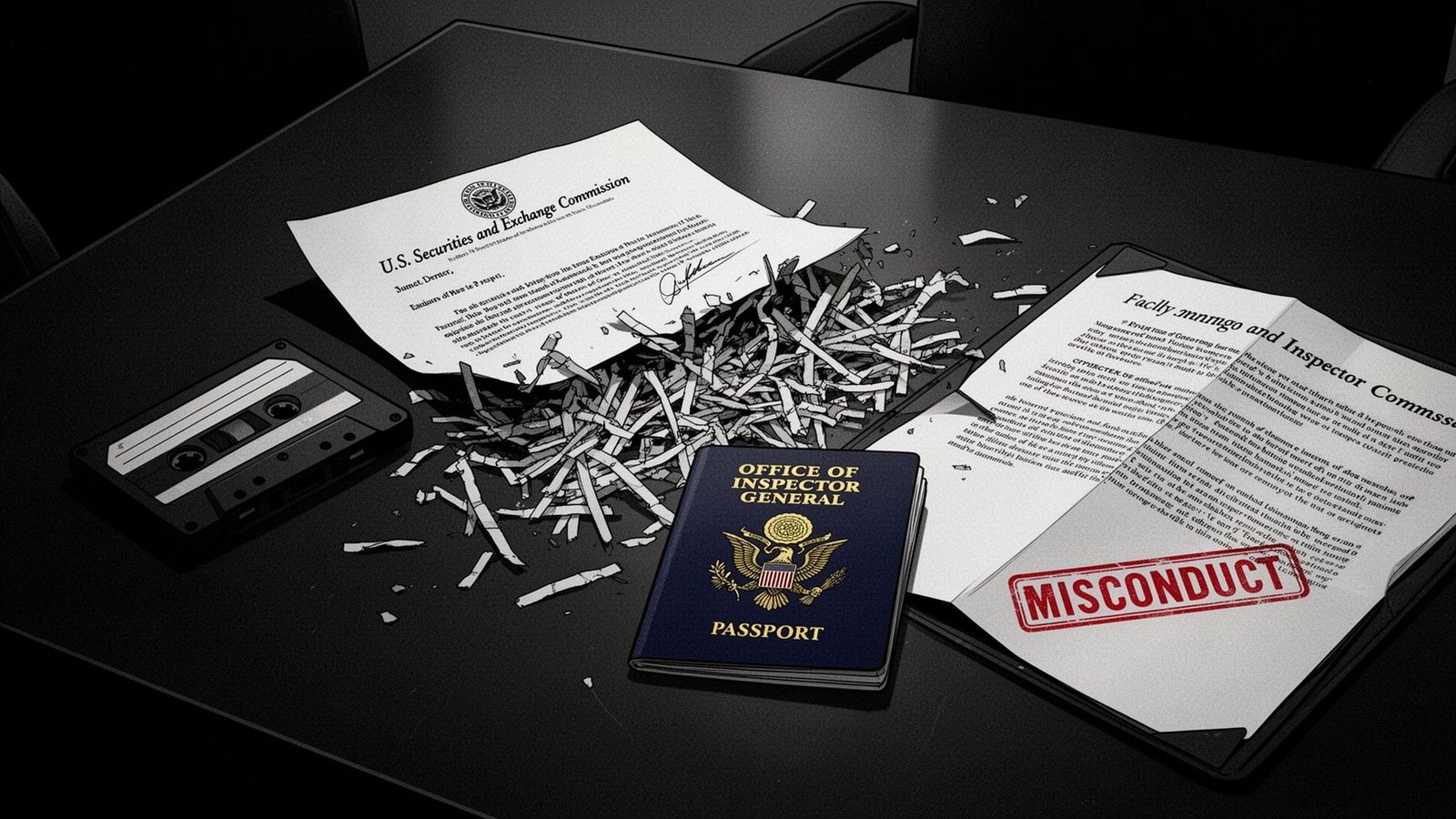
Parts I, II, and III of this series walked through what happened in the courtroom in 2024 and in the depositions in 2023. Part IV walks backward through the years before the trial — to 2015 and 2016, when the case the SEC tried in front of Judge Bloom in Miami was actually built.
In 2023 my counsel at Ford O'Brien Landy LLP prepared a complaint addressed to Deborah J. Jeffrey, the Inspector General of the U.S. Securities and Exchange Commission. The Office of Inspector General exists for exactly one reason: to investigate misconduct, fraud, waste, and abuse inside the SEC itself. Our complaint laid out, in legal-memorandum form, five categories of conduct by Sajjad Matin who ran the pre-litigation investigation into SureTrader. Every paragraph below traces to that draft, to the underlying Bates-numbered exhibits, and to the federal dockets.
What follows is the public-interest version of that document. Nothing in this piece is privileged communication; everything sourced to a docket, a statute, an SEC manual, or a published opinion is identified by name. The SEC staff attorney who ran the pre-litigation investigation into SureTrader, and whose conduct from August 2015 onward is described below, is Sajjad Matin. The official who ran the SEC's Division of Enforcement during the period when this case was litigated through the 2024 trial is Gurbir Grewal. Both are named here because accountability requires names.
What This Article Is
This is the fourth and most consequential piece in this series. The first three were about what twelve jurors saw and what they did not see in 2024. This one is about what the U.S. Securities and Exchange Commission did to a U.S. citizen between 2015 and 2019, in the dark, before any jury was empaneled.
If even half of what is laid out below is sustained on independent review, the 2024 verdict was not a flawed trial — it was the downstream consequence of pre-litigation conduct that, in our view, violated the SEC's own Enforcement Manual, the Model Rules of Professional Conduct, a sitting U.S. district court's stay order, the Fourth Amendment to the United States Constitution, and Bahamian privacy law. That is the predicate for an Office of Inspector General investigation. It is also the predicate for the use of the phrase that titles this piece: fraud on the court.
I am not asking any reader to take my word for it. I am asking readers to look at the dated, sourced sequence below and form an independent view.
The Setup — Why The SEC Was Even Looking At A Bahamian Brokerage
In 2015 the SEC had an open investigation under the file number FL-03848 captioned In the Matter of Traders Café. Traders Café was a US-based prop firm. SureTrader was a Bahamas-based broker-dealer that I founded and ran. Some Traders Café customers had also opened accounts at SureTrader. That is the entire factual connection that gave Sajjad Matin in Miami a foothold into a foreign broker-dealer with its own Bahamian regulator, its own Bahamian counsel, and its own Bahamian privacy laws.
The right move, under the SEC's own Enforcement Manual § 3.3.6.2 governing contact with witnesses residing overseas, was to consult the SEC's Office of International Affairs ('OIA'), prepare a Mutual Legal Assistance Treaty request or its equivalent, and work through the Securities Commission of the Bahamas ('SCB'). That is the formal channel that exists precisely so that one country's securities regulator does not direct private surveillance inside another sovereign nation.
Instead, what the record shows is that Sajjad Matin chose a different path.
August 17, 2015 — The Threat Letter To A Bahamian Employee
On August 17, 2015, while I was negotiating a possible settlement with the United States Attorney's Office for the District of New Jersey and the SEC after years of cooperation with the government, SEC Staff Attorney Sajjad Matin sent a letter directly to an individual Bahamian employee of SureTrader. The letter's re-line was In the Matter of Traders Café, SEC File No. FL-03848. The letter was addressed to the employee by name, not to SureTrader and not to SureTrader's counsel.
Without citing any legal authority, the letter told this Bahamian individual that '[y]ou have a duty to reasonably preserve and retain such Evidence,' that '[t]his duty includes an obligation to provide notice to all employees or custodians who may be in possession of Evidence,' that '[y]ou may need to act affirmatively to prevent the destruction of Evidence,' and that '[y]ou should consider preserving any forensically recoverable data by having mirror image copies made of the Evidence.' The letter closed with the line that matters: '[f]ailure to do so could give rise to civil and criminal liability.'
Pause on what just happened. A U.S. federal regulator, with no jurisdictional authority over a Bahamian national and no warrant, sent a letter to a foreign citizen on foreign soil and threatened him personally with civil and criminal liability if he did not start preserving — and by clear implication, producing — records of a Bahamian company. The Second Circuit has a name for that kind of pressure. It calls it government coercion sufficient to convert a private actor into a state agent. United States v. Stein, 541 F.3d 130, 151 (2d Cir. 2008).
August 24, 2015 — Bahamian Counsel Tells The SEC To Stop
One week later, Bahamian legal counsel for SureTrader wrote back. The response is short and it is the cleanest piece of paper in the entire pre-litigation record. Using the same In the Matter of Traders Café re-line, Bahamian counsel wrote:
'If you believe the United States Securities and Exchange Commission has the authority and/or jurisdiction to instruct a Bahamian company with regard to its records, please provide me with the appropriate citation. Otherwise, I respectfully request that you cease sending any correspondence to my client that seeks to compel conduct or otherwise threatens legal action based on a failure to comply with unauthorized and improper directives.'
To my knowledge, Sajjad Matin never provided the requested citation. There is no record of any response at all. The August 24, 2015 cease-and-desist from SureTrader's Bahamian counsel sits in the file unanswered.
That single unanswered letter is the foundation of Model Rule 4.2 of the ABA Model Rules of Professional Conduct, which Florida and every other U.S. jurisdiction have adopted in substance: 'In representing a client, a lawyer shall not communicate about the subject of the representation with a person the lawyer knows to be represented by another lawyer in the matter, unless the lawyer has the consent of the other lawyer or is authorized to do so by law or a court order.'
From August 24, 2015 onward, every direct contact between Sajjad Matin and a SureTrader employee about SureTrader business is a contact made over the express written objection of SureTrader's counsel. The whistleblower carve-out in Section 922 of the Dodd–Frank Act does not authorize that conduct. There is no opinion of the SEC's Office of the Ethics Counsel that authorizes it either. There is no court order. There is just an unanswered letter in the file.
March 10, 2016 — The Suspiciously Convenient 'Whistleblower' Complaint
Approximately seven months after the cease-and-desist, on March 10, 2016, the exact same Bahamian SureTrader employee Sajjad Matin had written in August 2015 filed a 'whistleblower' complaint with the SEC. The complaint's stated subject is, in substance, the exact same subject as the two August 2015 letters: it alleges that I 'provided platform for Traders Cafe to defraud clients,' and the complaint itself acknowledges, on its face, that SureTrader 'has received requests from the SEC for information about Traders Cafe before.'
Thirteen days later, on March 23, 2016, two things happened on the same day. The U.S. Attorney's Office for the District of New Jersey indicted me. The SEC sued me in the same court. The 'whistleblower' the SEC says walked in voluntarily and gave the agency its case had filed his complaint less than two weeks before the SEC pulled both triggers it had been holding.
The OIG draft says it plainly, and I will repeat it here: the closeness in timing of the March 10, 2016 whistleblower submission and the March 23, 2016 parallel indictment-plus-SEC-suit raises considerable suspicion. The proper subject of an Inspector General inquiry is whether Sajjad Matin had any role in encouraging the submission, suggesting it, drafting it, timing it, or coordinating it with the parallel filings already in the pipeline.
Spring 2016 — The Cease-And-Desist Is Treated As A Dead Letter
From the moment the 'whistleblower' submission is on file, Sajjad Matin treats the August 2015 cease-and-desist from SureTrader's Bahamian counsel as if it never existed. He starts emailing the employee directly, in detail, about subjects that have nothing to do with the four corners of the whistleblower complaint and everything to do with the broader SureTrader business.
On April 1, 2016, after a phone call, the employee writes back to the staff attorney: 'Further to our conversation today, I found some US client files where there was no Unsolicited Acknowledgement Agreement. I have attached them here. I also included the first page of their P&L to show that they were active. I also remember that there was a US firm that Guy had a stake in back in 2012 called Gbox Trading… I will try to locate their file on Monday. If you do decide to use any of these files, please remember to officially request them from us through the SCB.'
Read that last sentence again. The Bahamian SureTrader employee himself, in writing, reminded Sajjad Matin that if the SEC intended to use any of the documents he was sending, the SEC was supposed to go through the Securities Commission of the Bahamas. The employee understood the formal channel even where the staff attorney did not honor it.
The next week, the staff attorney wrote back asking for specific evidence about my role in two named affiliated entities, asking whether 'ProTrade was officially registered or required to file with any Bahamian authority,' and asking whether 'Guy or Justin keep any written agreements with Suretrader's affiliates (e.g., Timothy Sykes or DayTradingRadio.com).' He attached a confidential document the SEC had received in the underlying investigation and asked the employee for 'thoughts on the arguments presented,' with the request to 'treat as confidential the attached document and the statements made within.' A regulator is not supposed to be running a discovery operation by sharing confidential investigative material with a foreign witness and asking him to opine on it.
A few days later, the staff attorney thanked the employee for his 'help in guiding [the SEC] through the operational aspects of this matter.' Anyone who has been on the receiving end of state agency would recognize that sentence: it is the moment the relationship between government and informant becomes operational.
The Audio Recording The Staff Attorney Did Not Stop
Then comes the line that, more than any other in the OIG file, should have ended the SEC's case before it ever became the SEC's case. The Bahamian employee wrote to Sajjad Matin, in writing: 'I started making recordings of the [SureTrader] executive meetings (I made the first one today).'
Read that sentence as a U.S. district judge would. A foreign national, having been threatened in August 2015 with U.S. civil and criminal liability if he did not preserve company records, having been operationally cultivated by Sajjad Matin throughout March and April 2016, just told Sajjad Matin in writing that he is now secretly tape-recording his employer's executive meetings.
The staff attorney's response was the one that lawyers reach for when they know they are watching evidence be created in real time. He wrote back: 'I wanted to clarify that we are unable to provide any legal advice regarding the legality of making recordings under Bahamian law, and that we have not asked or required you to make any such recordings.'
He did not tell the employee to stop. He did not refuse the recordings. He did not refer the matter to the SEC's Office of International Affairs. He did not refer the matter to the U.S. Attorney's Office for ethics review. He papered the file with a disclaimer and then asked his next substantive question — about whether the employee was 'aware of any accounts held by Swiss America [SureTrader] with an Australian bank named Capital Security Bank Limited.'
Under Stein and Skinner v. Railway Labor Executives' Association, 489 U.S. 602 (1989), the question whether a private actor has become a Fourth Amendment agent of the state turns on the government's encouragement and the government's participation. A federal regulator who threatens, cultivates, requests, thanks, and then explicitly does not stop an informant from secretly recording his employer is not a neutral collector of voluntary testimony. He is, on these facts, the operational handler of an informant.
April 20, 2016 — The Informant Warns His Handler
If anyone wants to know how the Bahamian employee himself understood the relationship, his own words on April 20, 2016 are in the file. He wrote to Sajjad Matin: 'Guy is in town. And I overheard the IT person stating that they may be looking into ways to block or notify the system if someone forwards work emails from the company to their personal email. I will try to stay up-to-date with the IT guy to know for sure.'
Informants warn their handlers about counter-surveillance. Whistleblowers do not. That is a sentence from inside an operation.
May 12, 2016 — A Federal Court Stays The Case, And The SEC Investigates Around It
On May 12, 2016, the U.S. District Court for the District of New Jersey stayed the SEC's civil case against me 'pending the entry of a judgment in the Parallel Criminal Proceeding.' ECF No. 8 in SEC v. Gentile, 2:16-cv-01619 (D.N.J.). The stay was reaffirmed on April 12, 2017 (ECF No. 16), extended on May 12, 2017 (ECF No. 24), and tightened by text order on June 12, 2017: 'The parties shall not conduct any discovery in this matter prior to the resolution of Defendant's forthcoming motion to dismiss' (ECF No. 32).
The SEC's litigators in the New Jersey civil action thought they had built in an escape hatch by stipulating that the stay would not alter 'the Commission's right to continue to investigate other matters, by means of administrative subpoenas or otherwise.' ECF No. 8. That stipulation does not authorize the conduct that followed.
Through the spring and summer of 2016 and into 2017, while the federal docket in New Jersey was formally stayed, Sajjad Matin in the FL-03848 investigation continued his email relationship with the Bahamian employee. On May 25, 2016 — thirteen days after the stay was entered — the employee forwarded the staff attorney a message from the assistant of SureTrader's legal counsel. On August 2, 2016, Sajjad Matin took an administrative deposition that, by the SEC's own description in subsequent filings, focused predominantly on attempting to elicit negative information about me personally.
Then, on April 26, 2017, the SEC wrote the New Jersey court asking to lift the stay. The candor of the request is striking. The agency argued: 'Gentile continues to make his living in the securities industry, operating an on-line Bahamian broker-dealer, SureTrader, and retaining his affiliation with a US broker-dealer, Stock USA Investments, Inc. Therefore, obtaining an injunction from future violations against Gentile — an industry participant — as quickly as possible is of utmost importance for the Commission.' The same letter notes in a footnote that 'if the staff determines that documents obtained in the SureTrader investigation are relevant to the allegations in the instant Complaint, it will make them available to Gentile if and when discovery is allowed.'
Translated: the SEC was telling the same federal court that had stayed discovery that it had been simultaneously gathering documents, in a parallel investigation, that it intended to introduce in the case the court had stayed — and that it intended to use those documents to obtain prospective injunctive relief reaching into a foreign sovereign jurisdiction.
September 2017 — The First Dismissal, And The Bahamian Allegations Appear
On September 18, 2017, the U.S. District Court for the District of New Jersey dismissed the SEC's original complaint. ECF No. 46. On October 6, 2017, the SEC filed an Amended Complaint. ECF No. 47. The Amended Complaint did something the original had not done: it added paragraphs about me and the Bahamian broker-dealer I had founded. Am. Compl. ¶¶ 14, 82.
The Amended Complaint was carefully drafted to cite only publicly available information about SureTrader. But the question the OIG draft asks — and that we ask here — is where the SEC's litigators got the operational understanding of SureTrader's structure that allowed them to draft those new paragraphs at all. The most logical answer, on the public record, is that the staff attorney in Miami who had been running the In the Matter of Traders Café investigation since at least 2015 was providing information internally to the litigators in New Jersey, in substance circumventing the federal court's discovery stay.
On December 13, 2017, the New Jersey court dismissed the Amended Complaint as well. ECF No. 57. The Third Circuit remanded on September 26, 2019. The stay in New Jersey was finally lifted on December 17, 2019. ECF No. 66. The New Jersey court dismissed the SEC's Amended Complaint again on September 29, 2020 (ECF No. 109), and the SEC did not appeal that second dismissal.
Two complete dismissals, in the same federal court, of two consecutive SEC complaints. The SEC then refiled the substance of the same case in the Southern District of Florida in 2021 — case number 21-cv-21079, which became the trial Parts I, II, and III of this series cover. The documents and witnesses the SEC tried in Florida in 2024 are, in substantial part, the documents and witnesses developed in Miami between 2015 and 2019 in the FL-03848 investigation that the OIG draft addresses.
The Bahamian Regulator Was Told Things About Me That The SEC Could Not Back Up
While the SEC was litigating in New Jersey, the Securities Commission of the Bahamas was conducting its own examination of SureTrader. In its opposition to my motion to dismiss the Amended Complaint, the SEC cited the SCB's regulatory scrutiny of SureTrader as evidence of supposed wrongdoing. ECF No. 84 in 2:16-cv-01619 (D.N.J.).
What the SEC omitted from that filing, as the OIG draft alleges, is that the SCB's actions were spurred in significant part by the same SEC staff attorney making statements to the SCB about my conduct that were, in our view, false or misleading and that, in any case, were never tested in any adversarial proceeding before the SCB or in any U.S. court.
A U.S. federal regulator that cherry-picks a foreign regulator's reaction to its own off-the-record briefing, then cites that reaction back to a U.S. federal court as if it were independent evidence, has produced exactly the kind of circular record an Inspector General is supposed to unwind.
Five Categories Of Misconduct, Each Independently Sufficient
The OIG draft groups the conduct above into five legal categories. Each one is independently sufficient to warrant an OIG investigation. Together, they are the predicate for the use of the phrase fraud on the court.
One. Violation of Model Rule 4.2. From August 24, 2015 onward, every substantive contact between Sajjad Matin and a SureTrader employee about SureTrader business was a contact over the express written objection of the company's counsel. Florida's Rules of Professional Conduct mirror Model Rule 4.2 in substance. The whistleblower carve-out in Section 922 of the Dodd–Frank Act does not authorize the staff attorney to disregard a sister bar's rule of professional conduct.
Two. Violation of the federal court's discovery stay. From May 12, 2016 onward, the SEC continued investigating the same defendant whose civil case had been stayed by a U.S. district court, used the parallel FL-03848 file to do it, and ultimately used the fruits of that parallel investigation to draft an Amended Complaint that survived just long enough to be dismissed twice more.
Three. Fourth Amendment violation. The SEC staff attorney converted a Bahamian SureTrader employee into a Fourth Amendment agent of the state under Stein and Skinner — threatening him in 2015, cultivating him through 2016, asking him to find and forward documents, thanking him for his operational help, and then explicitly not stopping him from making secret audio recordings of executive meetings. The 'we have not asked or required you to make any such recordings' email is not a defense; it is a covering paper trail.
Four. Violation of the SEC's own Enforcement Manual. Section 3.3.6.2 of the June 4, 2015 Enforcement Manual instructs SEC staff to consult the Office of International Affairs 'as soon as the staff suspects any foreign connection to an investigation' and 'before attempting to contact a witness residing overseas.' OIA exists precisely to prevent the conduct documented above. There is no indication in the file that OIA was consulted before the August 17, 2015 letter, before the months of direct email contact with the Bahamian employee in 2016, or before Sajjad Matin spoke to the Bahamian regulator.
Five. Inducement of a foreign privacy-law violation. Bahamian law restricts the cross-border transmission of client information by Bahamian financial institutions. The SEC staff attorney's repeated requests for client files, P&Ls, and internal documents, sent to a Bahamian employee on Bahamian soil and producing transmissions out of the jurisdiction, induced the employee to violate that law. A U.S. federal regulator does not get to extract data from another sovereign's regulated entities by leaning on a single employee — that is what the Mutual Legal Assistance framework exists for.
Why This Is 'Fraud On The Court,' Not 'Bad Investigation'
Federal courts use the phrase fraud on the court for a narrow category of misconduct: conduct that 'defiles the court itself' or is 'a fraud perpetrated by officers of the court so that the judicial machinery cannot perform in the usual manner its impartial task of adjudging cases.' Hazel-Atlas Glass Co. v. Hartford-Empire Co., 322 U.S. 238 (1944); Aoude v. Mobil Oil Corp., 892 F.2d 1115, 1118 (1st Cir. 1989).
In our view, the conduct documented above clears that bar. The SEC's case in the Southern District of Florida in 2024 was tried on a documentary and testimonial record substantially developed through (i) direct contact with a SureTrader employee in violation of an express cease-and-desist from his employer's counsel; (ii) cultivation of that employee into a Fourth Amendment agent of the state; (iii) tolerated secret audio recording of corporate executive meetings; (iv) parallel investigation around a U.S. district court's discovery stay; and (v) off-the-record statements to a foreign regulator that were then cited back to a U.S. district court as if independent. The jury in 2024 was not told any of this. The trial judge was not asked to instruct on any of this. The verdict the SEC obtained in 2024 is, in our view, the verdict that record produces only because the conduct that built the record was hidden from the people who decided it.
That is the textbook structure of fraud on the court. It is also the textbook predicate for an Office of Inspector General investigation, which is why my counsel prepared one.
What I Am Asking The OIG, And The Public, To Do
I am asking the SEC Office of Inspector General to do the job Congress created it to do: independently investigate the conduct of Sajjad Matin who developed the FL-03848 file, who cultivated the Bahamian SureTrader employee, who contacted the SCB, who circumvented the New Jersey court's discovery stay, and who handed the resulting record to the SEC litigators who tried the case in the Southern District of Florida in 2024.
I am asking the public to read the dated, sourced sequence above and ask one question. If the U.S. Securities and Exchange Commission can do this to a U.S. citizen who built a regulated brokerage in another country, what protects any U.S. citizen who runs any cross-border financial business from the same playbook?
The OIG complaint is not the last document I will publish in this series. It is the document the rest of the series is built to make impossible to ignore.
Disclosure And Disclaimer
Disclosure: I, Guy Gentile, am a defendant in SEC v. MintBroker International, Ltd. and Guy Gentile, S.D. Fla. 21-cv-21079, and was previously a defendant in SEC v. Gentile, D.N.J. 2:16-cv-01619 (twice dismissed) and U.S. v. Gentile, D.N.J. 2:16-cr-00155 (dismissed). The draft Office of Inspector General complaint described above was prepared in 2023 by my counsel at Ford O'Brien Landy LLP. Quotations attributed in this article to the SEC staff attorney's correspondence and to the Bahamian employee's correspondence are drawn from documents Bates-stamped GENTILE0004374–GENTILE0004379 and related exhibits in our case file.
This article is an opinion column. Characterizations of motive, characterizations of legal categorization (including the use of the phrase 'fraud on the court'), and characterizations of the conduct of any individual SEC staff attorney are my opinions, based on the documentary record cited above. Nothing in this article is a finding of fact by any tribunal. Nothing in this article is legal, financial, investment, or tax advice. The Office of Inspector General, the Department of Justice, and any other authority with jurisdiction over the conduct described above are entitled to reach their own conclusions on the record.
Frequently Asked Questions
This essay reflects the personal views and opinions of Guy Gentile and is published for informational and educational purposes only. It is not investment advice, a recommendation to buy or sell any security, an offer or solicitation, or a research report. Markets carry risk and any positions, setups, or names discussed may change without notice. Mr. Gentile and parties affiliated with him may hold, add to, reduce, or close positions in the securities discussed at any time. Do your own research and consult a licensed financial professional before making investment decisions. Past performance is not indicative of future results.
Premarket notes, trade setups, and op-eds — free, in your inbox. Read more →