MU And SNDK Targets Hit — Long SNDK From $1,340 After-Hours, SPY 740 Is The Line
Memory targets paid. Friday delivered three washouts in SNDK — pre-market, the open, the close — each with a higher low. I re-entered long from ~$1,340 in Friday's after-hours with a mental stop at $1,300. The stock got a reality check from $2,350 as SK Hynix's SKHYV debut pulled liquidity. Here is whether the selling is done and where SPY has to hold.
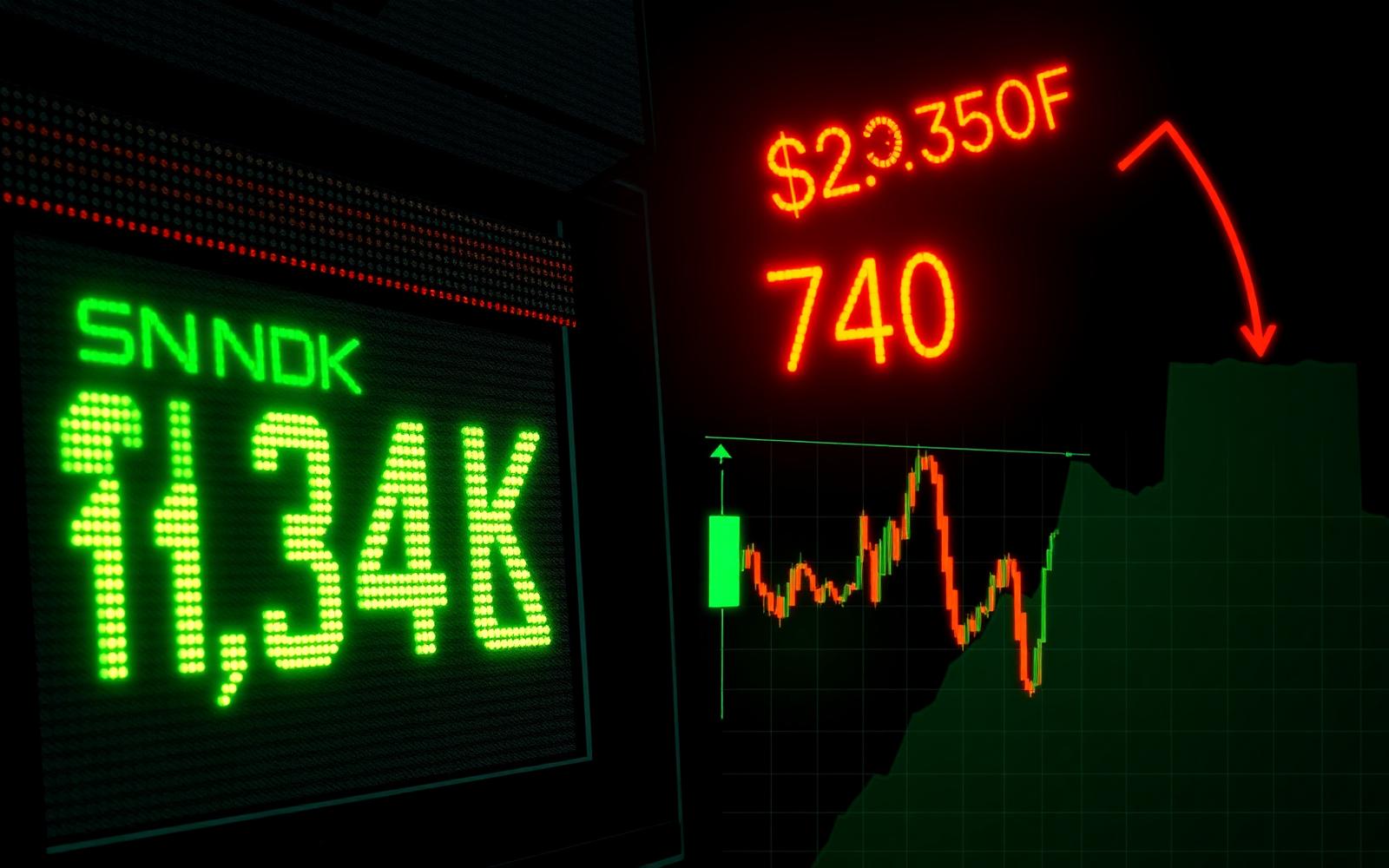
The MU and SNDK targets from the hyperscaler capex piece paid in full this week. That is the good news. The better question — the one I got about forty times over the weekend — is whether the selling is done and whether I flip long from here.
Short answer: I already did. I re-entered SNDK from the $1,340 area in Friday's after-hours session with a mental stop at $1,300. If $1,300 holds I ride it until it proves otherwise. If it breaks, I am flat and I wait for the retest. That is the whole trade.
The longer answer — why $1,340 after a $2,350 high is not the same tape as $1,340 on the way down, and why SPY 740 is the real decision line — is below.
Quotes delayed up to 15 minutes via public market data. Auto-refreshes every 60 seconds.
The Targets Paid — Now The Setup Changed
Two things are true at the same time. One, the memory calls I put on the tape in the MU capex and MU/SNDK hyperscaler pieces both hit their upside targets. Profits are real. Anyone who was in from the second July rip took money off. That is done.
Two, once a trade pays and the tape rolls, you do not automatically own the next leg. The thesis that worked from the entry — hyperscaler capex is under-modeled, memory is the tightest link — is still intact. What changed is the crowding. Everybody who wanted to be long MU and SNDK was long into Friday. When the tape wobbled, the same crowd sold first and asked questions second. That is what a market unwind looks like — it is a positioning event, not a fundamentals event.
So the question is not 'was I right on memory.' The question is: was Friday the end of leg one, or the start of leg two down. Different trade, different sizing, different stop.
Three Washouts, Three Higher Lows
Friday's tape in SNDK did something specific. Three separate flush events — pre-market, right after the cash open, and into the closing bell — and every single one printed a higher low than the one before it. That is not distribution. Distribution rolls; it does not build a staircase off the lows.
The pre-market flush cleared the overnight longs from Thursday's close. The 9:30 flush cleared the retail chasers who thought they were catching the pre-market low. The 3:45 flush cleared the funds that had to be flat into the weekend on risk mandates. Each seller was a different animal and each one printed a shallower low. That is forced-seller exhaustion. It is the same footprint I look for on a capitulation Friday.
The after-hours candle then closed green off that third low. That is where I got long — $1,340 area — because the after-hours print told me the desk wasn't stuck with inventory into Monday. If someone had been forced to move size, the AH would have broken $1,300 and stayed there. It didn't.
$2,350 → $1,340 — Why The Reality Check Makes Sense
SNDK put in a high near $2,350 before it rolled. From that print to Friday's after-hours entry is roughly a forty-three-percent haircut. That sounds violent until you overlay the calendar.
SK Hynix's ADR — trading as SKHYV on Nasdaq — priced $149 and opened $170 on the cross for the biggest foreign listing in US history at roughly $26.5 billion raised. When a $26-plus-billion supply event lands in a specific sub-sector, the funds who want the new paper have to make room. The way they make room is by trimming what they already own in the same theme. Read: MU and SNDK.
That is a mechanical unwind. It is not the market saying the AI-memory thesis is broken. It is the market saying 'I have to fund a huge new allocation and my sector risk budget is fixed.' The Friday recap piece flagged that MU and SNDK did not sell off on the debut day itself — that was the initial tell that the thesis had a real bid. What happened this past week was the delayed rebalance — the rest of the crowd finally got around to trimming the incumbents to fund the SKHY position they built at the open.
That is why $1,340 does not feel like the beginning of a real down move to me. It feels like the tail end of a positioning event.
The SNDK Trade — Long From $1,340, Mental Stop $1,300
Entry: ~$1,340, Friday after-hours. Mental stop: $1,300 — sits just below the third washout low from the closing flush. That is a roughly three-percent stop on the entry, which is tight enough that if I'm wrong I know inside the Monday open.
Why mental and not a hard stop: opening prints in AI-memory names on a Monday after a Friday unwind can be noisy for the first five minutes. I do not want a bad tick to knock me out of a trade I intend to hold. If SNDK trades $1,300 on a real print with volume behind it, I am flat by the time the last zero drops.
Upside: no target yet. If $1,300 holds Monday, the higher-low structure from Friday is confirmed and I am not selling into strength. I ride it until the tape proves otherwise. First real check is a reclaim of Friday's mid-day range on volume; second is a break back through the pre-market flush high. Above that the path opens toward the previous shelf that was distribution on the way down.
Sizing: this is a swing, not a scalp. I sized it to survive Monday's noise, not to press it into a Monday rip.
SPY 740 — That Is The Real Line
None of this trade lives in a vacuum. SNDK is a beta-2 name on the AI-memory theme; it does not fight the tape. So the question underneath the SNDK question is: what does SPY do at 740.
740 has been the swing pivot for two weeks now. It is where CTAs unwound leverage on the way down, where vol-target funds re-added on the bounce, and where dealer gamma flips from positive to negative below it. Above 740, dealers dampen. Below 740, dealers amplify. Every trade in high-beta AI-memory implicitly bets on which side of 740 the tape wants.
If SPY holds 740 into Monday's cash session, the Friday three-washout higher-low structure in SNDK is real, and the long is a good long. If SPY breaks 740 on volume and does not reclaim it in the first hour, the tape is telling you Friday was leg one of a bigger unwind and I am out of SNDK before the print through $1,300.
That is the whole hierarchy. SPY 740 is the master. SNDK $1,300 is the local invalidation. Both have to fail for the flip-long thesis to die.
Was This A Shakeout Or Is The Memory Trade Done?
Here is how I read it. The memory trade — as a fresh momentum trade — is done for now. The names ran, the crowd got long, the targets paid, and the crowd got taken out on a supply event. You are not going to get the second-July setup back next week.
The memory trade — as a swing off Friday's higher-low structure — is very much alive. Different trade, different timeframe. This is a mean-reversion long into a still-intact multi-quarter thesis, not a chase of the breakout that already ran.
Anyone still holding the runners from the earlier entries should be honest about it — those are new entries at these prices, not held longs from $900. Ask yourself whether you would open this position fresh at $1,340 with a stop at $1,300. If yes, hold. If no, take the tax hit and re-enter clean.
The Playbook Into Monday
Above SPY 740 on Monday: SNDK long stays on, first add on a reclaim of Friday's mid-day range, MU is a sympathy add on the same trigger with its own stop below the equivalent Friday low.
SPY loses 740 in the first hour and does not reclaim: I am flat SNDK by lunch, do not care about the $1,300 print, do not chase MU. Sit on hands into Wednesday.
SPY chops around 740 and closes near it: hold the SNDK long, do not add, let Tuesday tell you.
Bull case: three washouts and a higher low are what a bottom looks like. SKHYV supply cleared, SPY holds 740, MU/SNDK reclaim range, tape grinds back toward the highs into the next earnings window.
Bear case: Friday was a warning shot, SKHYV lockups and the broader IPO calendar keep pulling liquidity out of incumbents, SPY loses 740, memory rolls another leg. Bear case dies above 740 and confirms below it — that is the only line I care about.
Invalidation: SNDK prints and holds below $1,300 on volume, or SPY loses 740 and does not reclaim in the first hour. Either one is enough. Both is exit-first-ask-later.
The Bottom Line
The MU and SNDK targets are paid. The reason SNDK got a $2,350-to-$1,340 reality check has a name — SKHYV, twenty-six-and-a-half billion in fresh memory paper landing in the same sector — and that is a mechanical event, not a broken thesis.
Friday put in a three-washout higher-low structure. I re-entered SNDK from $1,340 in the after-hours with a mental $1,300 stop. If $1,300 holds I ride it. If SPY holds 740 I press it. If either breaks I am flat and I wait for the retest.
Nothing but death stops the guy who trades levels instead of stories. See you Monday.
Not Financial Advice
Everything on this page is my opinion based on the tape and on publicly available disclosures as of Friday's after-hours session, July 17, 2026. It is not investment advice and not a recommendation to buy, sell, or short any security. Prices, positioning, and options flow move fast, and any level, entry, or stop discussed here can invalidate the same session. I'm long SNDK from around $1,340 in Friday's after-hours as of publication. Verify independently before risking capital.
This essay reflects the personal views and opinions of Guy Gentile and is published for informational and educational purposes only. It is not investment advice, a recommendation to buy or sell any security, an offer or solicitation, or a research report. Markets carry risk and any positions, setups, or names discussed may change without notice. Mr. Gentile and parties affiliated with him may hold, add to, reduce, or close positions in the securities discussed at any time. Do your own research and consult a licensed financial professional before making investment decisions. Past performance is not indicative of future results.
Premarket notes, trade setups, and op-eds — free, in your inbox. Read more →